

Reimagining Surgery Through Video: Dr. Ari Wes on Surgical Cameras, AI, and the Future of Operative Analytics
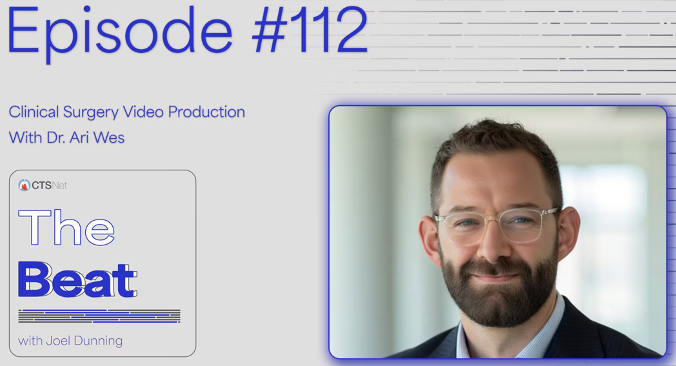
In this an episode of The Beat, a CTSNet podcast, host Dr. Joel Dunning sits down with Orchid Surgical’s CEO Dr. Ari Wes to explore the future of surgical video and its rapidly growing role in advancing surgical practice. Dr. Wes, a practicing plastic surgeon in San Francisco, shares how his personal frustrations with conventional video solutions led to the founding of Orchid Surgical — a company dedicated to creating state-of-the-art head-mounted cameras and AI-powered tools for surgical video editing and advanced analytics.
The interview covers practical strategies for integrating video into everyday surgery, from selecting the right optics to overcoming common challenges like lighting contrast and field of view. Dr. Wes emphasizes the importance of recording every case, not just showcase procedures, and making surgical video a routine part of the workflow.
Together, Dr. Dunning and Dr. Wes delve into how surgical video:
· Enhances team engagement by providing the entire OR a real-time view
· Acts as a black box recorder for postoperative review and quality improvement
· Enables AI-generated operative reports and lays the foundation for better documentation, accreditation, and ultimately patient outcomes
Looking ahead, Dr. Wes outlines a vision where AI and video analytics transform surgical education, documentation, and performance improvement — moving us toward a world where every surgeon can learn from peers globally without leaving their operating room.
Read the transcript here, or head on over to the CTSNet website and have a listen!
Dr. Dunning: Hello, my name is Joel Dunning and I’m here with an extremely special video. I love to do videos and CTSnet is all about capturing the amazing work that health surgeons do. But we have got a proper world expert for you. Ari Wes, so great to have you on the call. Now you’re a plastic surgeon in the San Francisco area, but of course you got obsessed with videos. In fact, you got so obsessed you co-founded a company that actually even makes head cameras, which is truly incredible. But I want to wind you all the way back to the very beginning, because I bet I’m guessing in your practice you were wanting to show the world some amazing videos, but you were making some muck ups. It wasn’t going well. So maybe tell us how things started and what things frustrated you at the beginning and how you found some solutions to those problems.
Dr. Wes: Sure. Thanks, Joel. And thanks for having me. Really excited to be here. You know, before I ever wanted to make videos to share with other people, I was in training and I just wanted to make videos for my own records. I was taking notes on cases and reviewing those notes before I would do a similar case. And the notes were just inherently kind of limited by the granularity that I could imbue them with when I did the case the first time. And so I started going really deep on what my options for filming were. I went down this rabbit hole that many of us have been down, which is looking at all these different options of cameras that are $5,000 to $25,000 and have towers and all this other stuff. And it just became super, and I increasingly started to have a hunch that there was a better way. I was looking at the amazing cameras that GoPro was making. They didn’t work well for a surgeon, but they’re amazing. And I didn’t think they were any more complex than what we needed or less complex than what we needed, just different. And that was the impetus for me trying to look for something better.
Dr. Dunning: And basically sort of when you were trying to do videos, the things that frustrated me were really stupid things like it being out of focus, not quite being in the view of my loupes, being too dark, being too light. I tried a GoPro and it was just terrible. It’s too wide view. What sort of things are the most simple tips and hints for the person who wants to video straight away?
Dr. Wes: Yeah. So you nailed the two big ones for me, which were dealing with the bright overhead lights or the darkness of a particular shadow in the operative field relative to the brightness, but the high contrast areas, and the field of view. The field of view on action sports cameras is a wide angle, 100 degree field of view. When you’re standing over your patient and operating, that is the opposite of what you want. You want somewhere between 30 and 60 degrees, depending on the types of cases you do. For both of those issues, contrast and field of view, there isn’t so much advice that I can give a surgeon other than you have to pick the right camera that satisfies those needs. A 4K image that’s 100 degrees wide means your effective resolution of your actual patient and the operative site is tiny, super low. You got to start with the right camera for sure.
Dr. Dunning: Yeah, absolutely. And I guess my other number one tip for all open surgeons out there is record everything. Don’t just wait till you’re a big case because some Captain Cockup will come to town. I’m sure you’d agree with that.
Dr. Wes: 100%.
Dr. Dunning: And I guess you’d agree that really find a camera you can use every single day. Would you agree with that?
Dr. Wes: It’s so spot on. I love talking to similarly minded surgeons. The interesting cases are not the cases that you think are going to be the interesting cases. They’re the ones that you think are going to be routine, and they end up being interesting. And sometimes they don’t even end up being interesting intraoperatively. Sometimes they end up being interesting because of what happens postoperatively. This idea of surgical video as like a black box flight recorder type piece of data that you can go back to and review if things go wrong postoperatively, or things go right postoperatively, I think that’s a really interesting use case.
Dr. Dunning: And of course, there’s two very different ways of mounting a camera. One’s in your head, one’s in the light. I wonder how you’ve balanced that. I bet you’ve tried both. What are your views on light versus head?
Dr. Wes: You’d be hard pressed to find a person who doesn’t think the best view in the operating room is the view that the surgeon has. So if we agree with that premise, then the best possible video comes from a head mounted camera. But a head mounted camera brings about a bunch of other complicating factors — inadvertent head movement, intentional head movement. All of these pose challenges. The light mounted or stationary mount camera only has one thing going for it — stationary. But filming the back of your head is not super valuable. It has to be on your head, set to your field of view, your line of sight, and then you hit record and forget about it. We think those issues with head mounted cameras are solvable — the lookaways, the inadvertent movement — with tech that polishes the video.
Dr. Dunning: One of the pushbacks I get is, I can’t use my favorite headlights, or it’s sore on my head. So I’m guessing what you might say is find a camera that’s compatible with your headlight and use a light camera. Would that be right?
Dr. Wes: Exactly. There’s nothing inherent about a head mounted camera that means it has to be heavy or tethered or have a built-in light. A GoPro type configuration is light, can sit on your head, you’re untethered, and it can work with your headlight. That’s what we think the right solution is for sure.
Dr. Dunning: I think I’m with you really that every single day of the week is a head mounted camera. And I guess from what we’re saying is wear it every single day, get used to it, make it part of your daily routine. Always remember to turn it on. I had a guy who got so excited about a case, he never actually turned the damn thing on.
Dr. Wes: We’ve all been there.
Dr. Dunning: And of course record it and then just save that footage straight afterwards, isn’t it?
Dr. Wes: Absolutely. There’s an ancillary benefit of filming — giving your staff in the room a real-time view of what you’re seeing. It sucks them right into the case. The other piece is the storage. These files are big. When I started building my own camera, in one week my one terabyte hard drive was full. So you’ve got to have a storage solution worked out — scalable, cloud-based, secure — ideally HIPAA compliant or your country’s equivalent.
Dr. Dunning: Absolutely. Couldn’t agree more. And actually when I started recording routinely, I found residents were asking for videos for their operative logs, and that’s fantastic for training.
Dr. Wes: We’re bullish on the future of surgical video. Education, documentation, accreditation — these are areas where video will play a role. And down the road, improving outcomes with AI by quantifying what expert surgeons do that improves results.
Dr. Dunning: One of the tangible things is creating an operation note from selected cases. Is that nearly here?
Dr. Wes: For a limited set of cardiac cases we’re demoing AI operative notes — aortic valve, mitral valve, CABG — generating an operative report within 24 hours. It’s based purely on visual data.
Dr. Dunning: So it can actually tell the valve you’re putting in or more the steps?
Dr. Wes: Some things like valve size are non-visual. If we don’t pick it up in the audio, we leave it blank and the surgeon fills it in.
Dr. Dunning: The sky really is the limit now with AI and cloud. How do you see five years from now?
Dr. Wes: The majority of surgeons in academic positions will be filming most cases. Traveling to observe will be a thing of the past. Documentation will be more accurate, and video will start to inform outcomes — things like optimal hemostasis or valve bite spacing — powered by AI.
Dr. Dunning: This is just super exciting. Thank you for being such a pioneer in this. The challenge is getting surgeons to film, upload, and share — but with cloud and better cameras, we’re nearly there, aren’t we?
Dr. Wes: Exactly. It’s no longer cost or time prohibitive. We owe it to ourselves, our colleagues, and our patients to train like professional athletes, review game tape, and optimize our craft.
Dr. Dunning: Amazing. Thank you so much for joining us on this CTSnet video and for all you’ve done to make cardiac surgical videos more recordable and easier to see.
Dr. Wes: Thanks, Joel. Thanks for having me.
If you’re interested in how Orchid Surgical’s head-mounted cameras and AI tools can help you transform surgical education, documentation, and analytics, take a look at what we are up to! Start building your own library of operative videos — and unlock new possibilities for improving outcomes, collaboration, and training.